

MyTech Group Berhad (formerly known as Widetech (Malaysia) Berhad) was incorporated in Malaysia as a private limited company under the Companies Act 1965 on 25 January 1984. The company was converted to a public limited company on 30 May 1995 and was subsequently listed on the Second Board of the Bursa Securities on 18 March 1997.
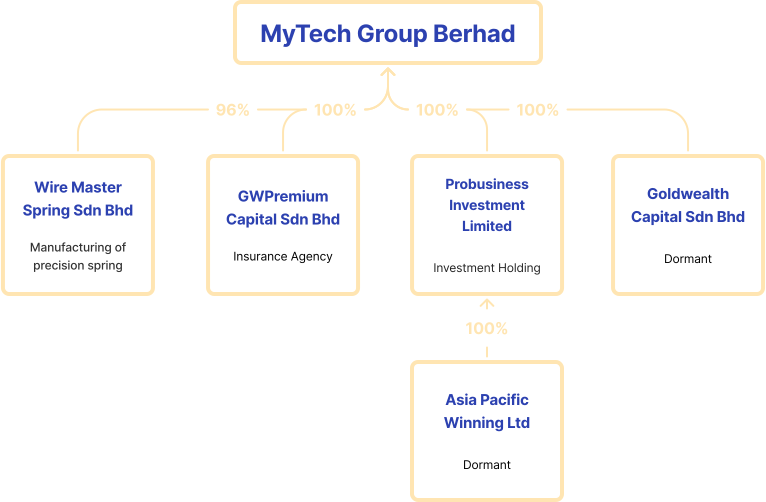
MyTech is an investment holding company whilst the principal activities of its subsidiaries are manufacture of precision springs and provision of services.
The principal investment strategy of MyTech has always been to continuously identify and invest in sectors with high growth potential and to expand businesses within those sectors.
Executive Chairman
Executive Director
Executive Director
Non-Independent Non-Executive Director
Executive Director
Independent Non-Executive Director
Independent Non-Executive Director
Datuk Dr Ng Bee Ken
Eng Szi Lok
Elisa Tan Mun-E
Lim Sek Wah (MAICSA 0799845)
Tang Chi Hoe – Kevin (MAICSA 7045754)
Level 15-2
Bangunan Faber Imperial Court
Jalan Sultan Ismail
50250 Kuala Lumpur
Tel : (03) 2692 4271
Fax : (03) 2732 5388
Mega Corporate Services Sdn Bhd
Level 15-2 Bangunan Faber Imperial Court
Jalan Sultan Ismail
50250 Kuala Lumpur
Tel No: (03) 2692 4271
Fax No: (03) 2732 5388
Grant Thornton Malaysia PLT
Maybank Berhad
Public Bank Berhad
CIMB Bank Berhad
RHB Asset Management Sdn Bhd
AHAM Asset Management Berhad
*Mr Choo Weng Wah has resigned w.e.f 10th March 2025
The principal investment strategy of MyTech has always been to continuously identify and invest in sectors with high growth potential and to expand businesses within those sectors.
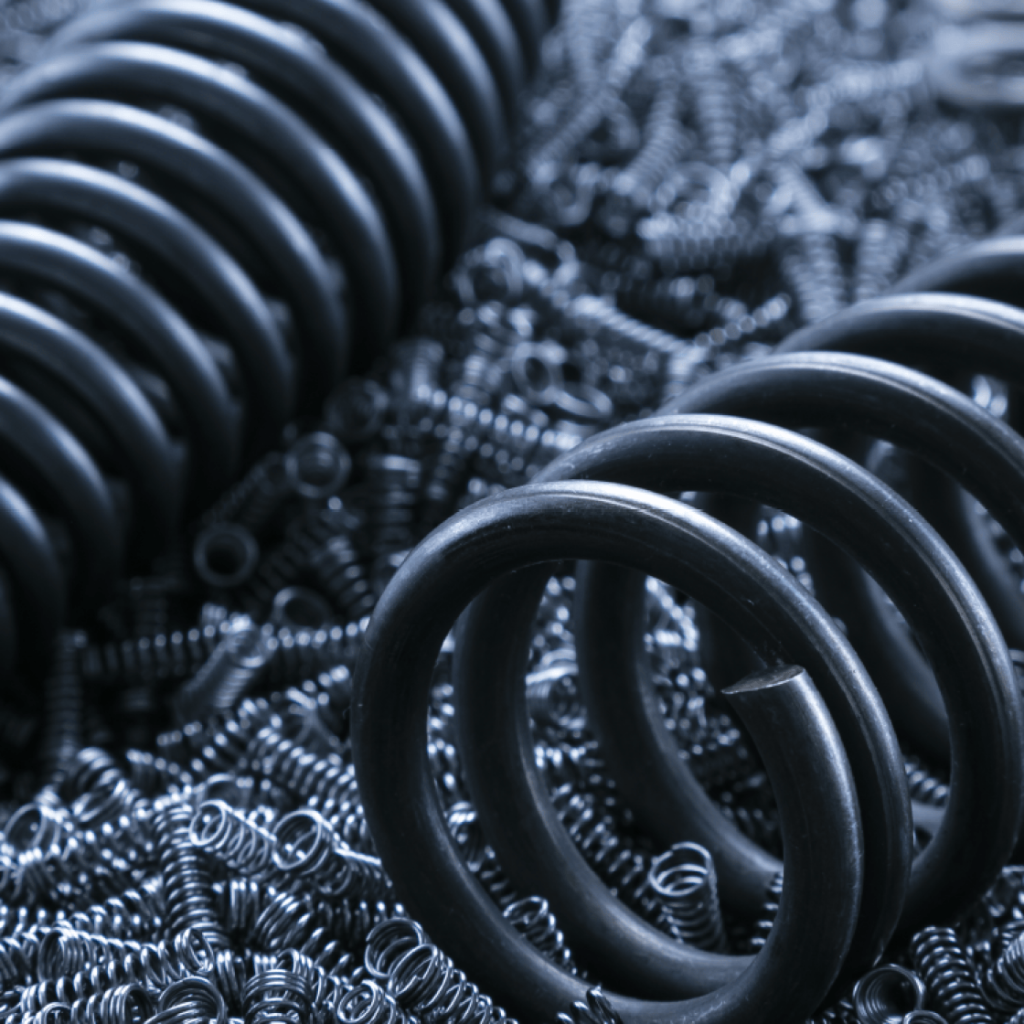
WMS specialises in the manufacture of precision springs, which are used in a cross section of industries ranging from electrical and electronics to automotive and general household and consumer products. The company has a diversified clientele base, of which are many multinational corporations from Malaysia as well as those in overseas such as Europe, Middle East, South East Asia and South Pacific. A wide range of machines are used in the production, such as fully automated mechanical and computer controlled coiling machines, wire forming machines, heat treatment facilities, precision tool-making machines etc. WMS operates from its 40,000 sq. ft. factory in Penang, Malaysia. WMS’s range of 40 precision spring making machines reflects the company’s prominent status as one of the leading precision spring maker in this region.
GWP is principally engaged in the business of financing and insurance agency. GWP offers various general insurances to corporations and individuals. The Group is exploring the business opportunities of GWP who is also a licensed moneylender.
PRO was established principally as an investment holding company and acts as a holding company for the Group’s overseas investment.
ASIAPAC is presently dormant.
The Group will strive for sustainable, capital efficient and profitable growth.
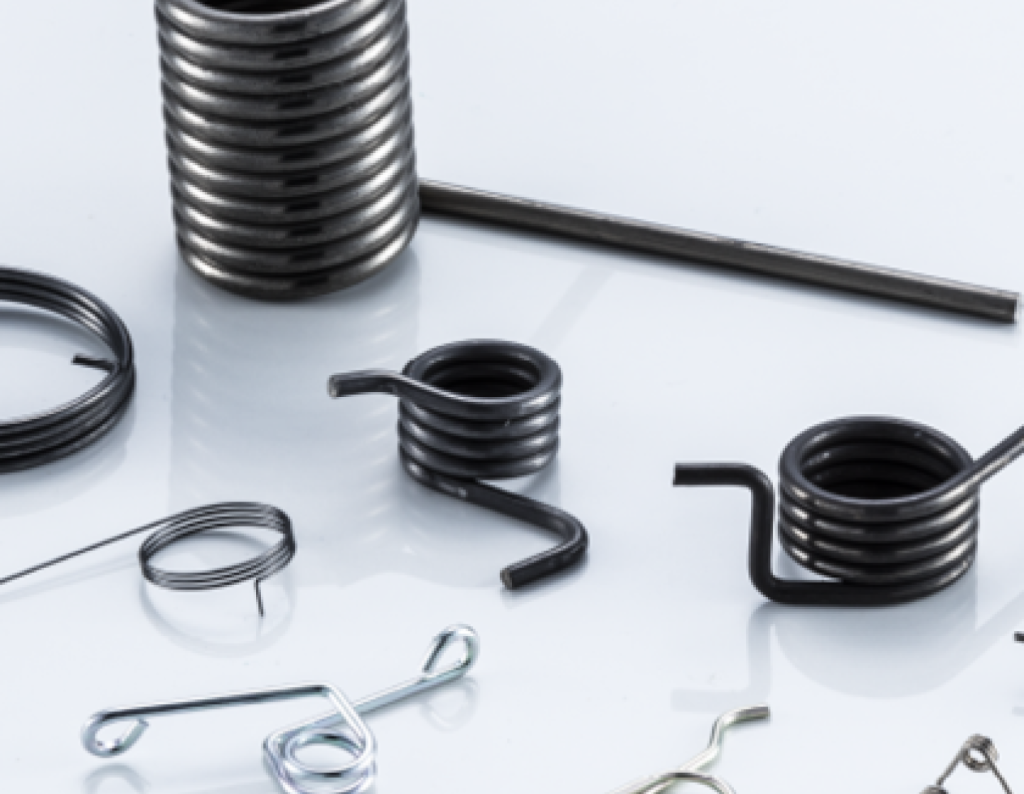
Torsion springs are designed and wound to be actuated rotationally, and to provide an angular return force. They are used in all types of hinges and assemblies such as self-closing doors and lids. There are often many options for leg configuration so the spring can be attached in different ways. The most important size parameters to consider when searching for torsion springs include design units and dimensions. Design units can be specified in English or metric units. Some manufacturers may specify both. Important dimensions include inner diameter, outer diameter, wire diameter, and spring length. The inner diameter is typically specified when the spring is required to slip over a mandrel with sufficient clearance to operate freely. The outer diameter is typically specified when the spring is required to fit into a circular hole with sufficient exterior clearance to operate freely, or if there are outer housing clearance issues. The wire diameter is the diameter of the actual spring wire. The spring length is the length of the spring coil.
Important performance specifications to consider when searching for torsion springs include spring rate, maximum deflection, maximum load, and wind specifications. Spring rate is the angular return torque provided per unit of angular displacement. The maximum deflection is the maximum rated angular deflection of spring before damage. The wind of the torsion spring can be right hand, left hand, or double torsion. Double torsion wind springs have one right-hand and one left-hand wind on the same spring, usually with an unwound section between the winds. The two legs emerge from the spring on the same side. Leg specifications to consider for torsion springs include leg angle, equal leg length, and leg end style. Springs that are straight or parallel on the same side are considered to have a 0° leg angle. Increasing angle is in the unwinding direction. Some legs have equal length. Leg end style choices include straight torsion, straight offset, hinged, short hook ends, and hook ends.
Choices for materials and finish for torsion springs are also important to consider. Common materials of construction include hard drawn steel, music wire, spring steel, stainless steel, other metals, and non-metallic. Music wire is a common and relatively inexpensive high-carbon steel alloy used for spring manufacture. It is cold drawn and offers uniform tensile strength. Spring steel is a standard industrial grade of steel specifically used for spring making. It exhibits good elastic and return properties. Stainless steel exhibits good corrosion resistance for specialty applications. Exotic metals and their alloys with special properties and applications; include such materials as beryllium copper, beryllium nickel, niobium, tantalum, and titanium. Plastic is a broad category including all thermoplastic materials used by custom spring winding service providers. Plastic springs may be used in light-to-medium duty applications for quiet and corrosion-resistant qualities. Finishes include none, black oxide, gold irridite, passivate, and zinc.
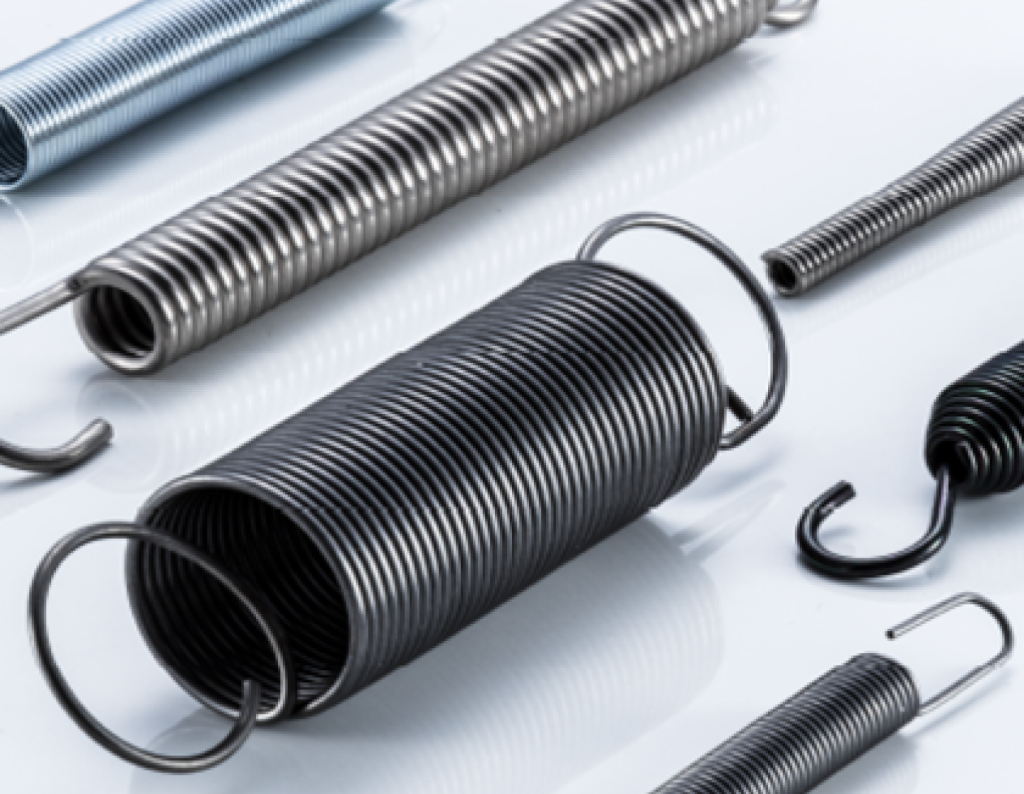
Tension springs are wound to oppose extension. They are often fully compressed in the no-load position and have hooks, eyes, or other interface geometry at the ends to attach to the components they connect. They are frequently used to provide return force to components that extend in the actuated position.
The most important parameters to consider when searching for extension springs are the dimensions. These include outer diameter, wire diameter, and free length. The free length is the overall length of a spring in the unloaded position. Other important considerations include design units. Design units can be specified in English or metric units. Some manufacturers may specify both. Important spring parameters to consider when searching for extension springs include the maximum load, the spring rate, and the extended length. The maximum load is the load at full extension. The spring rate is the force per unit spring deflection. The extended length is the length at full rated extension.
Common materials of construction for extension springs include stainless steel, high carbon steel wire, alloy steel or music wire, nickel base alloy wire, brass, and hard drawn. Spring steel is a standard industrial grade of steel specifically used for spring making. It exhibits good elastic and return properties. Music wire is a common and relatively inexpensive high-carbon steel alloy used for spring manufacture. It is cold drawn and offers uniform tensile strength. Stainless steel exhibits good corrosion resistance for specialty applications. Exotic metals and their alloys with special properties and applications; include such materials as beryllium copper, beryllium nickel, niobium, tantalum, and titanium. Plastic is a broad category including all thermoplastic materials used by custom spring winding service providers. Plastic springs may be used in light-to-medium duty applications for quiet and corrosion-resistant qualities.
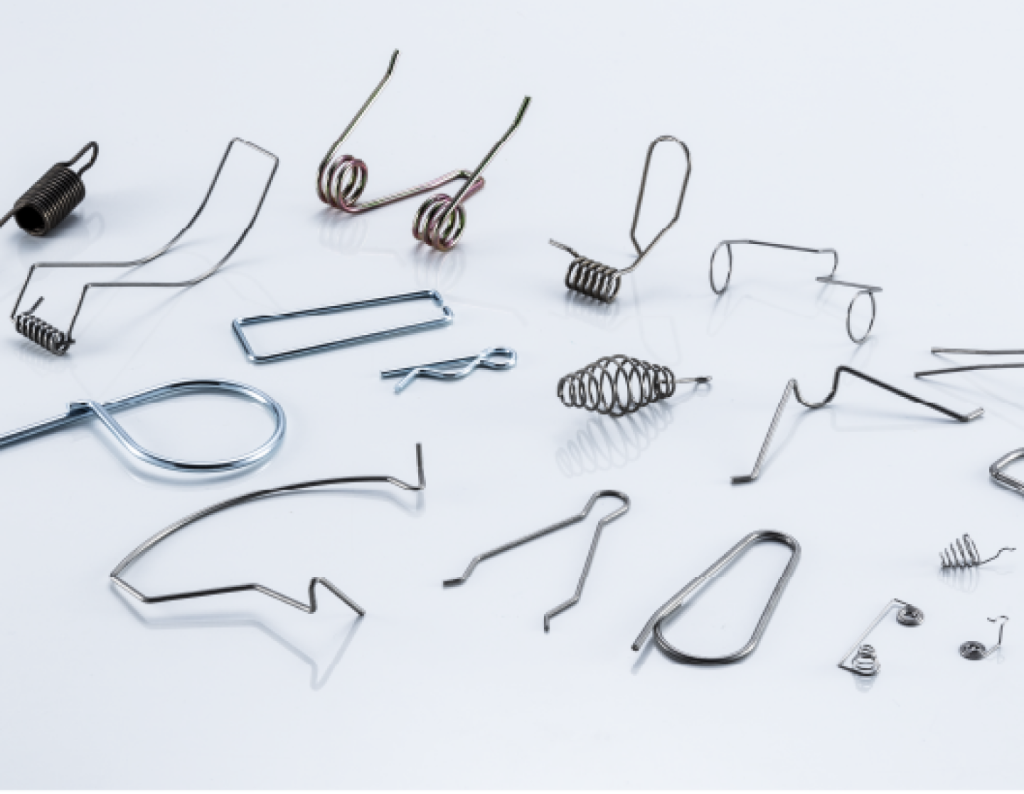
Special Profile springs are designed for specialized or proprietary applications. There are several types of industrial springs including a steel spring, stainless steel spring, steel wire spring, leaf springs, coil springs, and industrial springs. A spring manufacturer, compression spring manufacturer, and torsion spring manufacturer distribute springs through a spring supplier.
Specialty springs are produced in several ways. Industrial springs can be formed out of several alloys as well as stainless steel. A compression spring is an open coil helical spring that provides resistance when a load is applied against it. The load causes the coil to collapse at a specified rate of pounds per inch. Most compression springs are single diameter. Round wire is the ideal choice when producing compression springs, and is available in various diameters and types through a steel. Round wire springs can be produced by a spring manufacturer with standard tooling, thus reducing cost. A torsion spring is usually a closed coil helical spring with ends formed to provide torque when load is exerted on the ends. A properly designed torsion spring will reduce in coil diameter when loading. Coil springs are resilient metal shafts that are wound into a spiral that may be compressed or extended without permanent deformation. Leaf springs are long, flat, thin springs consisting of several layers of metal springs that are bracketed together.
Specialty springs have a wide variety of applications and are used in most industries. In the automotive industry, they are used in both front and rear suspension systems in cars. The spring coils cushion and absorb shocks and bumps as the vehicle is driven. Specialty springs are also used in all types of hinges and assemblies such as self-closing doors and lids. Special springs are widely utilized in industrial machinery. Tolerances are determined by material specifications standards for wire manufacturing. Distortion during coiling can slightly change the wire diameter in specialty springs.
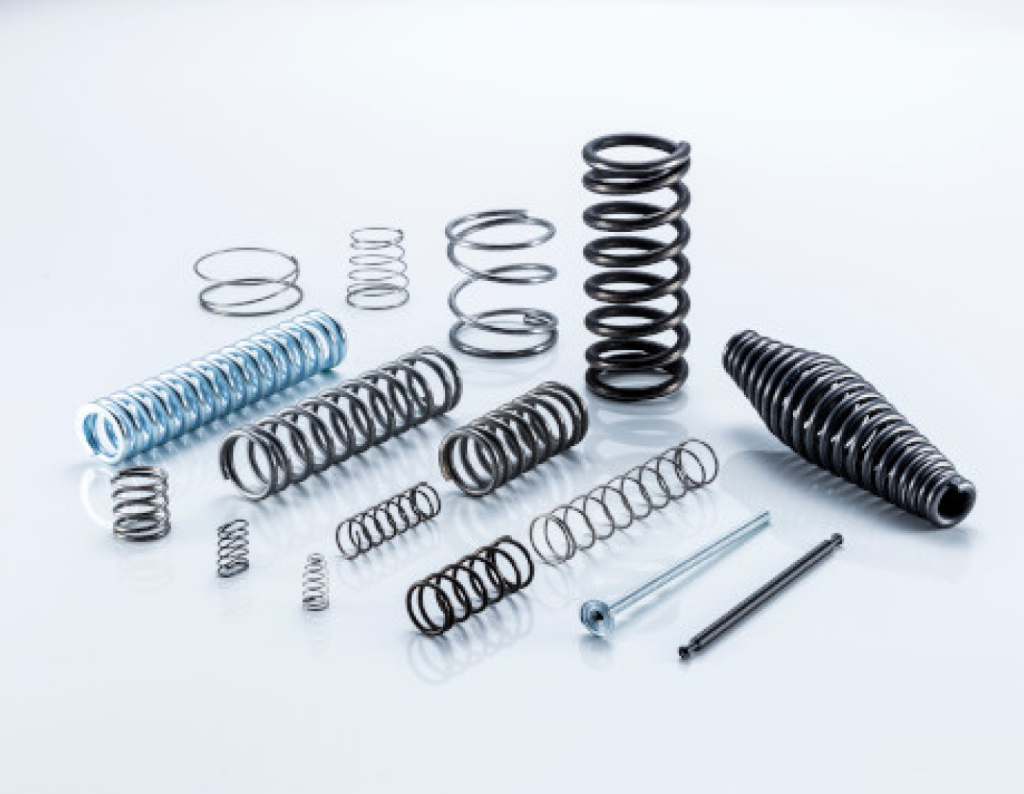
Compression springs are wound or constructed to oppose compression along the axis of wind. They can be wound in constant or variable pitch along their length, be constructed of stacked spring elements, and can be straight, conical, or have a variable diameter. The most important parameters to consider when searching for compression springs are the dimensions. These include outer diameter, inner diameter, wire diameter, free length, and solid height. The free length is the overall length of a spring in the unloaded position. The solid height is the length of a compression spring when under sufficient load to bring all coils into contact with adjacent coils. Other important considerations include spring rate and design units. The spring rate is the change in load per unit deflection, generally given in pounds per inch or Newtons per millimeter (N/mm). Design units can be specified in English or metric units. Some manufacturers may specify both.
Common materials of construction for compression springs include stainless steel, high carbon steel wire, alloy steel or music wire, nickel base alloy wire, brass, and hard drawn. Spring steel is a standard industrial grade of steel specifically used for spring making. It exhibits good elastic and return properties. Music wire is a common and relatively inexpensive high-carbon steel alloy used for spring manufacture. It is cold drawn and offers uniform tensile strength. Stainless steel exhibits good corrosion resistance for specialty applications. Exotic metals and their alloys with special properties and applications; include such materials as beryllium copper, beryllium nickel, niobium, tantalum, and titanium. Plastic is a broad category including all thermoplastic materials used by custom spring winding service providers. Plastic springs may be used in light-to-medium duty applications for quiet and corrosion-resistant qualities. Configuration options for compression springs include straight coil, ground ends, closed or squared ends, and die spring. A straight coil configuration is a standard coil type for compression springs. Other coil types are hourglass, conical and barrel types.
A compression spring that has ground ends has one end that is ground to provide a flat plane. In a closed or squared ends configuration the ends of the compression spring where pitch of the end coil is reduced so that the end coils touch. Die springs are helical compression springs generally of rectangular section. They can carry roughly 30% more load for the same deflection than can be carried by a round section. They are not solely used in dies but find application in clutches, brakes, farm machinery and aircraft mechanisms.